In an Upcoming Presentation, I will highlight the Impact of Truth even when it is ignored, sidelined or misconstrued. Like a Pearl, Truth can actually be reinforced by attempts to Supress it. Very often, efforts against Truth serve as Beacons inspiring the Pursuit of Truth for those Dedicated to Truth!
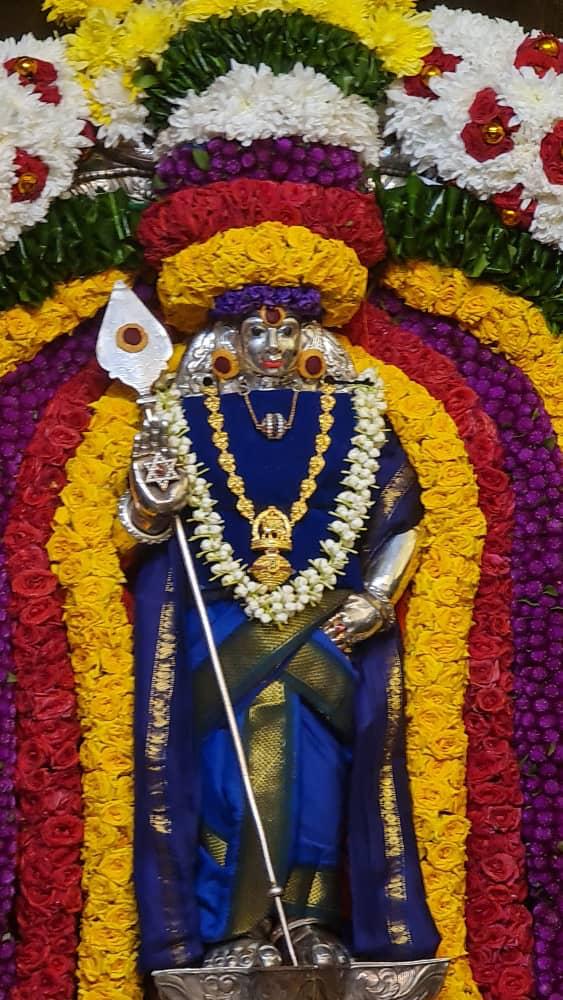
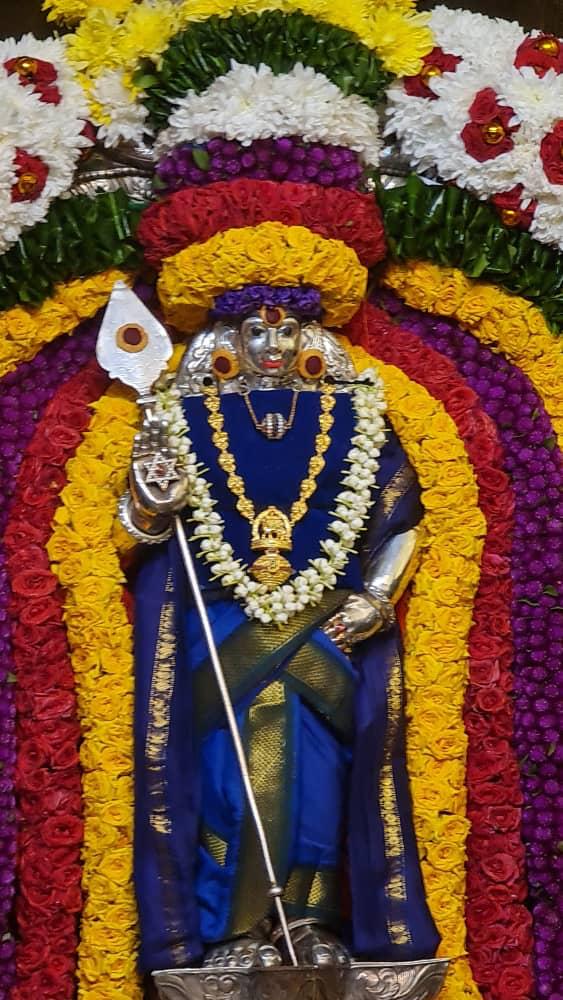
Lord Muruga is the most popular Hindu deity among the people of Tamil Nadu. He is the son of Lord Shiva and Parvati, his brother is Ganesha and his wives are Valli and Deivayanai, he is known by different names like Subramanya, Subramani, Muruga, Shanmuga, Skanda, Karthilkeya, Arumuga and Kumaraswamy. Muruga is intimately associated with hilly regions, known in Tamil as Kurinji and is worshipped as the guardian deity. Lord Muruga is a special God with special powers. By worshipping lord Muruga with deep devotion, faith and Bhakti all the troubles and difficulties in ones’ life vanish and good days start appearing.
Tri-Loka = Three Locations, Upper-Swarga, Bhu-Middle and Patala-Lower. Earth is in the Middle Realms and Negativity comes with the territory. Such Negativity is inbuilt by the Creator. Why? As a reminder to our true selves, the Soul, the Jiva-Atman, that these Tri – Loka material realms are not are real home.
Thus no matter a Being’s position or predicament outside of the Vai-Kunta (No-Anxiety) Spiritual Realms, there will always be anxiety and negativity. This is an undeniable fact regardless of the location, the society or the people or personalities involved.
Shatadanva Murdered Satrajit in the presence of his Daughter and Wife of Lord Krishna, Satyabhama
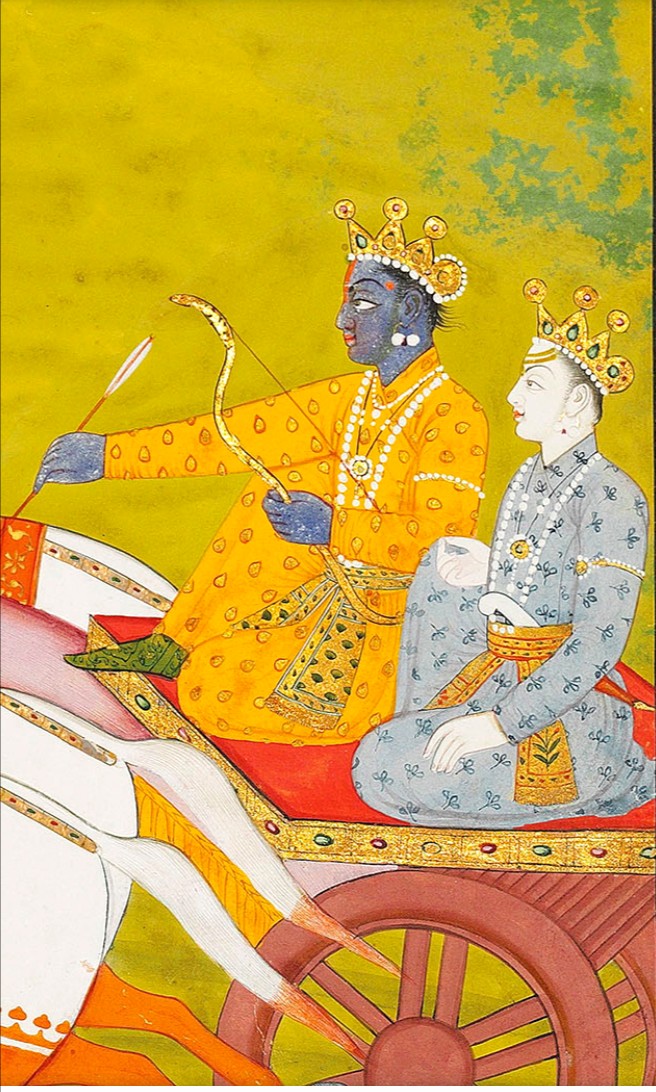
The ancient tale of the Shyamantaka, as recorded in the Srimad Bhagavat Purana, makes this vividly obvious. The Shyamantaka Jewel was a miraculous Gold producing Gem. The legend around it is a tale of human frailties and societal pithiness, jealousy, intrigue, mystery and murder. Initially, Lord Krishna himself was suspected of murder, then after the brutal murder of his father-in-law, Satrajit, Krishna and Balarama tracked down and killed the murderer Shatadanva in a cross continental chase.
This tale took place in Dwarka, the famous now sunken city built by Krishna and Balarama. It had been created as a refuge for the Yadus/the Yadavas. A group of residents of this city of Dwarka, and actual members of Krishna’s own clan, decided to murder Satrajit. Why? There were actually two camps involved.
Satrajit offers his Daughter Satyabhama in Marriage to Lord Krishna
One group was outraged after Satrajit gave his daughter Satyabhama in marriage to Lord Krishna. “The chief conspirator was Śatadhanvā. Along with others, Śatadhanvā wanted to marry Satyabhāmā, the beautiful daughter of Satrājit. Satrājit had promised that he would give his beautiful daughter in charity to various candidates, but later on the dec wasision was changed, and Satyabhāmā was given to Kṛṣṇa along with the Syamantaka jewel.”Krsna Book
The other group of conspirators, albeit with nobler intentions, was led by Krishna and Balarama’s uncle and cousin Akrura and Kritavarma. “Akrūra and Kṛtavarmā joined the conspiracy because they wanted the Shyamantaka jewel for Kṛṣṇa. They knew that Kṛṣṇa wanted the jewel and that Satrājit had not delivered it properly.” Krsna Book
Their response? Break into Satrajits home and knife him to death in front of his entire family including his daughter Satyabhama, the wife of Lord Krishna.
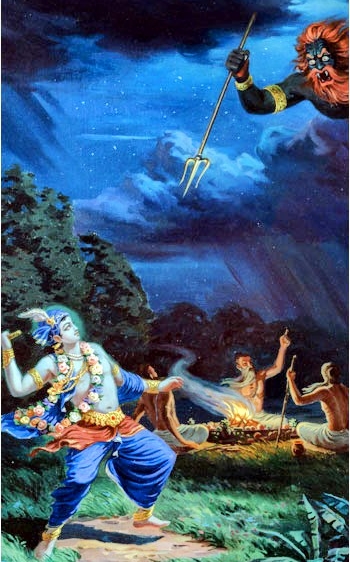
Krishna and Balarama Prepare to Kill Shatadanva
It is an incredible story of greed, jealousy, spite, murder and retribution. ‘The Killing of Satrajit and Shatadanva‘ Krsna Book by A.C. Bhaktivedanta Swami Prabhupada
“When Kṛṣṇa was informed by Satyabhāmā of the murder of His father-in-law, He began to lament like an ordinary man. His great sorrow is, again, a strange thing. Lord Kṛṣṇa has nothing to do with action and reaction, but because He was playing the part of a human being He expressed His full sympathy for the bereavement of Satyabhāmā, and His eyes filled with tears upon hearing about the death of His father-in-law. He thus began to lament, “Oh, what unhappy incidents have taken place!” In this way both Kṛṣṇa and Balarāma, along with Satyabhāmā, the wife of Kṛṣṇa, immediately returned to Dvārakā and began to make plans to kill Śatadhanvā and take away the jewel. Although he was a great outlaw in the city, Śatadhanvā was still very much afraid of Kṛṣṇa’s power, and thus he became most afraid on Kṛṣṇa’s arrival.”
Despite the outwardly tragic circumstances, Lord Krishna, the all positive and prosperous supreme personality, brought all auspiciousness. As a direct result of his recovering the Shyamantaka Gem, Lord Krishna married two more beautiful princesses, Jambhavati and Satyabhama.
(1)The son of Vyâsa said: ‘When Krishna heard [the rumor] that the sons of Pându and queen Kuntî had burned to death [in the house of lac], He who exactly knew what had transpired, together with Balarâma went to the Kuru kingdom for His family obligations. (2) Meeting Bhîshma, Kripa, Vidura, Gândhârî and Drona They equally sorrowful said: ‘Ah how painful this is!’
(3) [Meanwhile in Krishna’s absence in Dvârakâ] Akrûra and [the Bhoja] Kritavarmâ saw an opportunity and said to S’atadhanvâ [‘hundredbow’, a bad character]: ‘Why not take the jewel? (4) He [Satrâjit] promised us his gem of a daughter, but ignoring us he gave her to Krishna. Why then should Satrâjit not follow his brother [in death, see 10.56: 13 and *]?’ (5) Thus influenced by the two that most wicked man, in his sinfulness shortening his lifespan, killed out of greed Satrâjit while he was sleeping [compare 1.17: 39]. (6) As the women [in Satrâjit’s residence] helplessly cried calling for help after he had killed him like a butcher kills animals, he took the jewel and disappeared.
(7)When Satyabhâmâ saw that her father had been killed, she thrown in grief lamented: ‘Oh father, alas oh father, with you being killed I am killed!’ and then she fainted. (8) Putting the corpse in a large vessel of oil she went to Hastinâpura to Krishna who [already] knew of the situation, and related sorrowfully the murder of her father. (9) The Lords hearing that, oh King, imitating the human ways both lamented with eyes full of tears: ‘Oh what a tragedy fell upon us!’
(10)The Supreme Lord then went back to His capital with His wife and elder brother, prepared to kill S’atadhanvâ and take the jewel from him. (11) When he heard about it, he in fear took action to save his life and asked Kritavarmâ for assistance. But he told him: (12-13) ‘I cannot commit such an offense against the Lords Râma and Krishna. How can anyone who causes Them trouble find happiness? Kamsa and his followers lost their wealth and lives because they hated Them and Jarâsandha lost after seventeen battles [even] his chariot!’
(14)Turned down by him, he next begged Akrûra for help. But he said likewise: ‘Who, knowing the strength of the Lordships, can oppose Them? (15-17) He who maintains, creates and destroys this universe as a pastime, He whose purpose is not even known to the secondary creators [headed by Brahmâ] who are bewildered by His invincible [mâyâ] potency, He who playing as a child of seven years old uprooted a mountain that He held up with a single hand like a boy holds a mushroom [see 10.25], Him, Krishna the Supreme Lord to whose wondrous acts there is no end, I worship. I offer my obeisances to Him who, as the source of all existence, is the Supreme Soul, the immovable center.’
(18)S‘atadhanvâ also being rejected by him, left the precious jewel with him, mounted a horse that could cover a hundred yojanas and took off. (19) Krishna and Râma mounted the chariot with the emblem of Garuda and pursued the murderer of Their respected senior with the fasted horses, oh King. (20) In a park in a suburb of Mithilâ S’atadhanvâ’s horse collapsed. He abandoned it and continued on foot in terror, with a furious Krishna after him who also ran. (21)With him on the run the Lord, on foot, severed with His sharp edged disc, his head from his body and then searched his upper and lower garments for the gem. (22) Not finding the stone, Krishna went near His elder brother and said: ‘S’atadhanvâ was killed in vain, he did not carry the jewel.’
(23)Balarâma then said: ‘S’atadhanvâ must have left the rock with some person, therefore go [back] to the city [of Dvârakâ] and search for him. (24) l myself wish to pay a visit to the king of Videha [the later Janaka, see 9.10: 11] who is most dear to Me.’ Having said this the descendant of Yadu oh King, entered Mithilâ [the capital of Videha]. (25) Seeing Him, the king of Mithilâ immediately, with a mind full of love, rose to his feet and honored Him who was so worshipable with all available means, as was prescribed. (26) He, the Mighty One, honored by the affectionate great soul Janaka, lived there in Mithilâ for several years. During that time He taught Duryodhana to wield the club.
(27)When Kes’ava the Almighty Lord arrived in Dvârakâ, He, to comfort His beloved [the grieving Satyabhâmâ], told her about the demise of S’atadhanvâ and the failure to get hold of the jewel. (28) He, the Supreme Lord, together with all friends then saw to it that the necessary ritual duties for the funeral of the deceased relative [Satrâjit] were performed. (29) As soon as the ones responsible, Akrûra and Kritavarmâ, heard that S’atadhanvâ had been killed, they out of fear went into exile, somewhere outside of Dvârakâ. (30) With Akrûra in exile ill omens arose for the residents of Dvârakâ. They continually experienced physical and mental troubles and had problems with other living beings and the higher powers [natural disasters included, compare1.14; 1.17: 19**]. (31) Some citizens my dear, were thus lost in guesses, forgetting completely what traditionally was said about Him, the refuge of the sages. How can with Him being present any calamity arise?(32) [They said:] ‘When Indra withheld the rains, the king of Benares [Kâs’î, see also 9.17: 4] gave his daughter Gândinî to S’vaphalka [Akrûra’s father, 9.24: 15] who visited him. Thereupon it indeed rained in Kâs’î. (33) Wherever Akrûra stays, his son who has his [father’s] prowess, lord Indra will shower rains and no painful disturbances or untimely deaths will be seen.’
(34)Hearing these words of the elders, Janârdana, convinced that this [absence of Akrûra] was not the only explanation for the omens happening [***], ordered that Akrûra should be brought back. (35-36) Greeting him with respect and honor and pleasantly discussing topics, He, fully aware of everything that went on in his heart, smiled and said: ‘We of course, oh master of charity, are already familiar with the fact that you at present are in the possession of the opulent Syamantaka jewel that S’atadhanvâ entrusted to you. (37) Since Satrâjit had no sons it are his daughter’s sons [she ànd her sons] who should receive his inheritance after having presented water, offerings and having cleared his remaining debts. (38-39) Nevertheless, the jewel should stay with you, because it is for others impossible to manage, oh trustworthy keeper of the vows. My brother however, does not fully believe Me concerning the gem. To bring peace to My relatives, please show it to Us now oh most fortunate soul who with your altars of gold uninterrupted continue with your sacrifices.’(40) Thus won over by the conciliatory words, the son of S’vaphalka took the gem hidden in his garment and handed over the jewel that shone as brilliant as the sun. (41) After showing the Syamantaka jewel to His relatives, [and thus] doing away with the emotions [of the accusations] against Him, the Lord returned it to him. (42) Whoever recites, hears or remembers this narration full of the prowess of the Supreme Controller Vishnu that most auspiciously removes all distress, will attain peace and drive away his sins and bad reputation.’
Note: This is an excerpt from a chapter of my book ‘Orissa in the Crossfire,’ titled ‘Some Dare Call it a Conspiracy’
The picture could not be more obvious. Within less than 8 years, three native sons who had risen to the role of leaders amongst their people, who had developed dedicated followings and also happen to be not only active but spectacularly successful in the promotion of Hindu culture, have been eliminated. In an area targeted by Christian terror outfits, Maoist terror or a deadly mix of both, these three native Hindu leaders dedicated their lives to the upliftment of their own people. For that reason alone, they were targeted for elimination.
We find very similar conditions in all three Indian States of Orissa, Manipur and Tripura.
Ongoing violent campaigns
Active, ongoing and focused Christian conversion drives
Large tribal populations
Native spiritual leaders with successful track records in humanitarian and Hindu cultural activism with large local followings
Strategic high resource value areas
All targets of previous threats or attempts upon their lives (Similar to Orissa’s Swami Lakshmananda, Iskcon Manipur and Shanti Kali’s Tripura Temple were frequent targets of threats and protection racket money demands.)
All targeted for assassination on Janmashtami day
Their deaths serve the goals of anti-National forces and radical Abrahamic conversionists.The aggressive attacks parallel each other in terms of method of operation, agenda and action. For this not to be a conspiracy, is beyond belief. Slowly but surely native local Hindu leaders, active within the targeted zones, are being eliminated.
Such figures were potential kingmakers whose one word could influence millions and decide the political outcome of elections. The pattern is clear. Any obstacle to the stated agenda of those dedicated to the dismemberment and debasement of India as a Nation will be removed. Any contender to the various anti-India terror groups for the loyalty of the people will be eliminated.
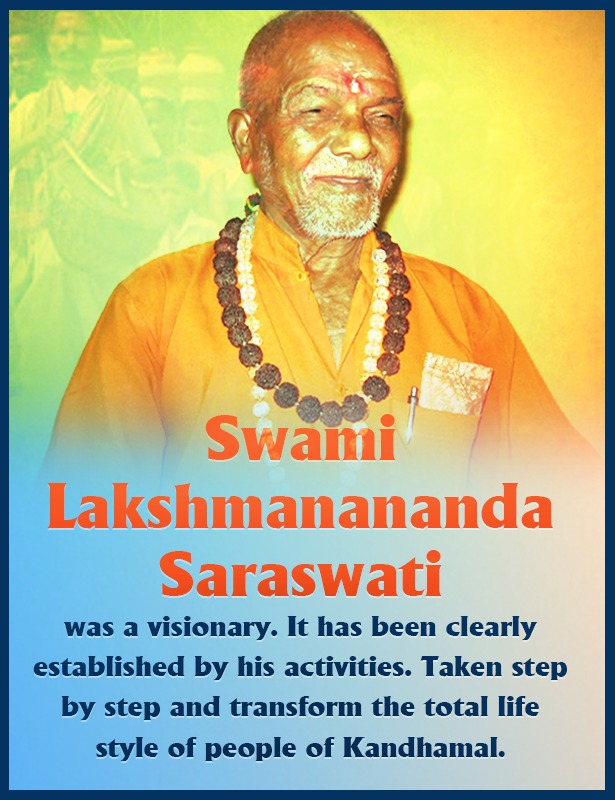
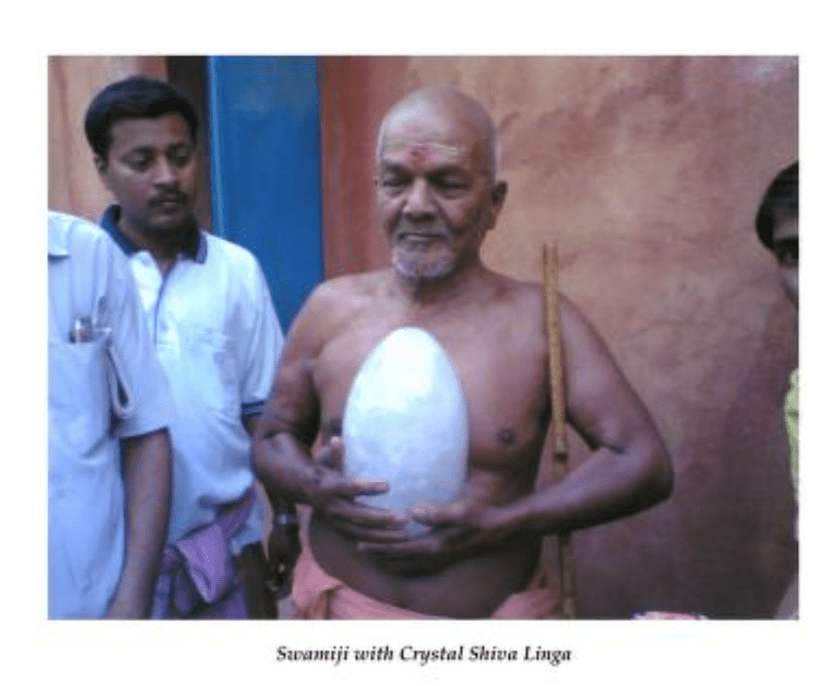
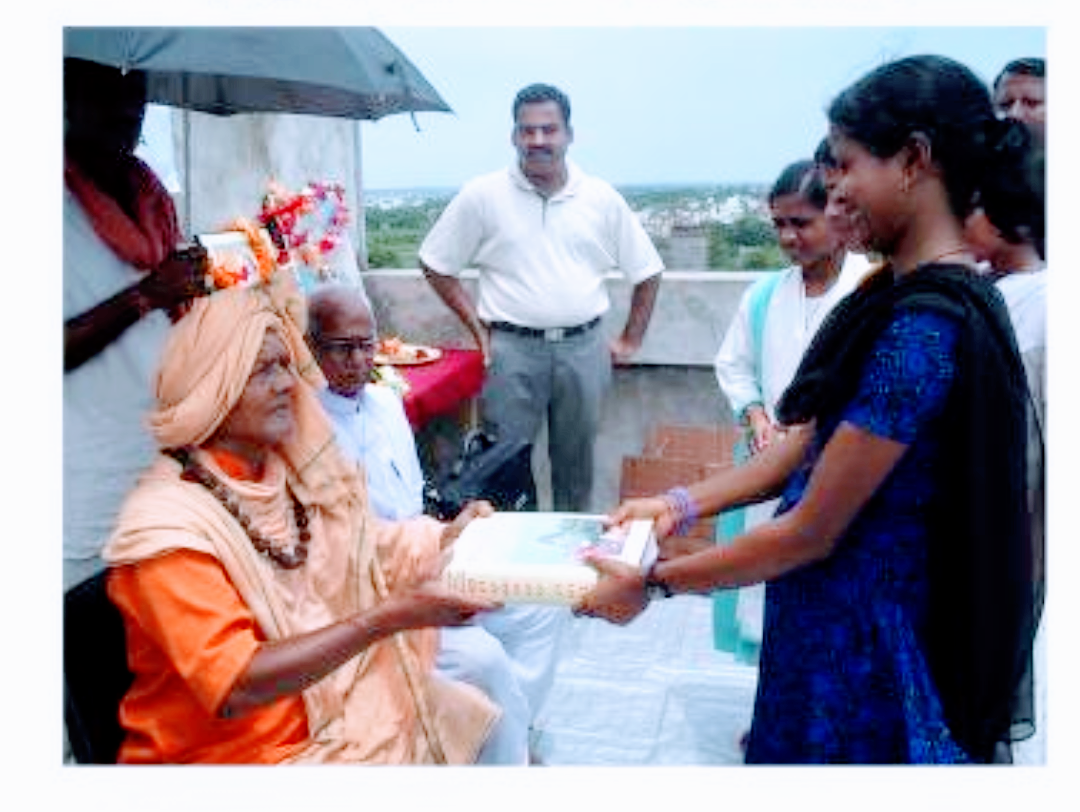
The Same Ancient War Against the Vedic Sages Continues Today. The mere acts of Yanja, Puja and Bhajan Counter the Demonic Potencies and have thus Always been the Targets of Destruction Bhaktisvarupa Damodara Swami (9 December 1937 – 2 October 2006), also known as Dr. Thoudam Damodara Singh and by the honorific Sripada (Śrīpāda), was a Gaudiya Vaishnava spiritual leader, scientist, writer and poet. In 1971 he received spiritual initiation from A. C. Bhaktivedanta Swami Prabhupada. A few years later he became one of the religious leaders of the International Society for Krishna Consciousness (also known as the Hare Krishna Movement). Despite claims of a ‘natural death’ the Swami died in Kolkata hospital a mere 7 weeks after the Janmashtami day terror attack Gurudev Santi Kali or Santi Tripura (died 27 August 2000) was a popular Hindu priest who was shot to death inside his ashram near Jirania under the Sadar subdivision in the Indian state of Tripura. Police reports regarding the incident identified ten members of the Christian terrorist organization National Liberation Front of Tripura (NLFT) as being responsible for the murder. In the same month, another Hindu leader of the Jamatya community, Jaulushmoni Jamatya, was also murdered.Swami Lakshmananda’s Gift of Vedic Literature to a graduate of one of his several Tribal Girl’s Schools
“And the Beast was allowed to make war against the saints and to conquer them, and was given power over every race, people, language and nation.” Holy Bible, Revelation 13:7
Note: This is an excerpt from a chapter of my book ‘Orissa in the Crossfire,’ titled ‘Some Dare Call it a Conspiracy’
The picture could not be more obvious. Within less than 8 years, three native sons who had risen to the role of leaders amongst their people, who had developed dedicated followings and also happen to be not only active but spectacularly successful in the promotion of Hindu culture, have been eliminated. In an area targeted by Christian terror outfits, Maoist terror or a deadly mix of both, these three native Hindu leaders dedicated their lives to the upliftment of their own people. For that reason alone, they were targeted for elimination.
We find very similar conditions in all three Indian States of Orissa, Manipur and Tripura.
Ongoing violent campaigns
Active, ongoing and focused Christian conversion drives
Large tribal populations
Native spiritual leaders with successful track records in humanitarian and Hindu cultural activism with large local followings
Strategic high resource value areas
All targets of previous threats or attempts upon their lives (Similar to Orissa’s Swami Lakshmananda, Iskcon Manipur and Shanti Kali’s Tripura Temple were frequent targets of threats and protection racket money demands.)
All targeted for assassination on Janmashtami day
Their deaths serve the goals of anti-National forces and radical Abrahamic conversionists.The aggressive attacks parallel each other in terms of method of operation, agenda and action. For this not to be a conspiracy, is beyond belief. Slowly but surely native local Hindu leaders, active within the targeted zones, are being eliminated.
Such figures were potential kingmakers whose one word could influence millions and decide the political outcome of elections. The pattern is clear. Any obstacle to the stated agenda of those dedicated to the dismemberment and debasement of India as a Nation will be removed. Any contender to the various anti-India terror groups for the loyalty of the people will be eliminated.
The Same Ancient War Against the Vedic Sages Continues Today. The mere acts of Yanja, Puja and Bhajan Counter the Demonic Potencies and have thus Always been the Targets of Destruction Bhaktisvarupa Damodara Swami (9 December 1937 – 2 October 2006), also known as Dr. Thoudam Damodara Singh and by the honorific Sripada (Śrīpāda), was a Gaudiya Vaishnava spiritual leader, scientist, writer and poet. In 1971 he received spiritual initiation from A. C. Bhaktivedanta Swami Prabhupada. A few years later he became one of the religious leaders of the International Society for Krishna Consciousness (also known as the Hare Krishna Movement). Despite claims of a ‘natural death’ the Swami died in Kolkata hospital a mere 7 weeks after the Janmashtami day terror attack Gurudev Santi Kali or Santi Tripura (died 27 August 2000) was a popular Hindu priest who was shot to death inside his ashram near Jirania under the Sadar subdivision in the Indian state of Tripura. Police reports regarding the incident identified ten members of the Christian terrorist organization National Liberation Front of Tripura (NLFT) as being responsible for the murder. In the same month, another Hindu leader of the Jamatya community, Jaulushmoni Jamatya, was also murdered.Swami Lakshmananda’s Gift of Vedic Literature to a graduate of one of his several Tribal Girl’s Schools
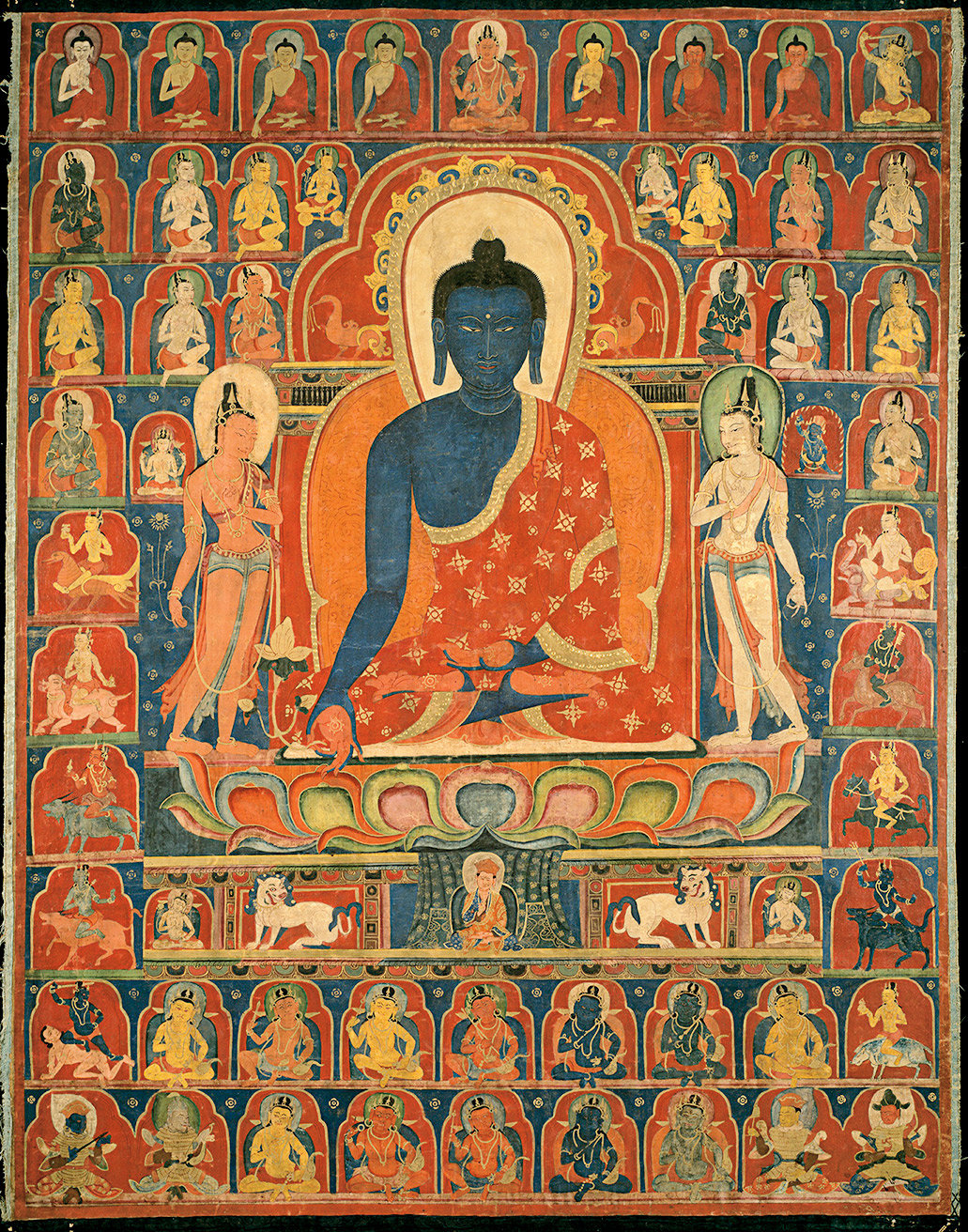
A 14th-century Tibetan painting on cloth of Bhaisajyaguru, or the Medicine Buddha, who is typically depicted with blue skin and holding an apothecary’s gallipot.Credit…Medicine Buddha (Thangka), circa 14th century, pigment on cloth, Tibet, Kate S. Buckingham Fund/Bridgeman Images
Note: I posted this to my old vediculture Yahoo group back in 1999, titled as the Vedic Buddha Date. As this website serves as a depository of the past 26 years of my work, some of it may have dated informationn, missing data etc. This article, in particular, has been used as a source by several scholars who found it credible. It therefore represents a unique contribution to the study of Buddha and the Buddhist historical timeline.
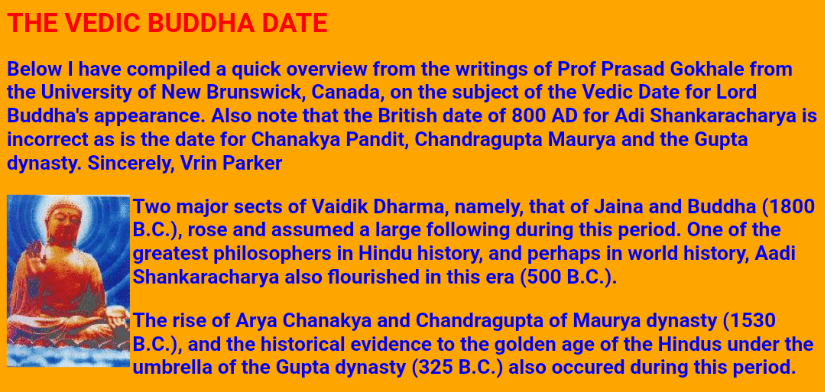
Below I have compiled a quick overview from the writings of Prof Prasad Gokhale from the University of New Brunswick, Canada, on the subject of the Vedic Date for Lord Buddha’s appearance. Also note that the British date of 800 AD for Adi Shankaracharya is incorrect as is the date for Chanakya Pandit, Chandragupta Maurya and the Gupta dynasty. Sincerely, Vrin Parker
Two major sects of Vaidik Dharma, namely, that of Jaina and Buddha (1800 B.C.), rose and assumed a large following during this period. One of the greatest philosophers in Hindu history, and perhaps in world history, Aadi Shankaracharya also flourished in this era (500 B.C.).The rise of Arya Chanakya and Chandragupta of Maurya dynasty (1530 B.C.), and the historical evidence to the golden age of the Hindus under the umbrella of the Gupta dynasty (325 B.C.) also occured during this period.. Evidence testifies that Buddha and Aadi Shankara lived 1800 B.C. and 500 B.C respectively.
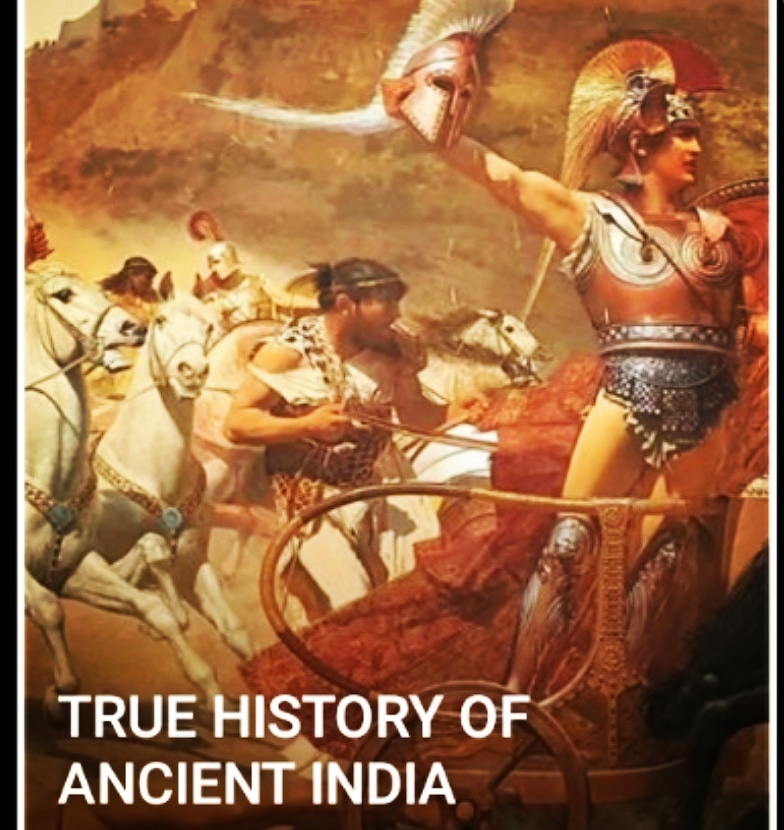
The “golden age” in India was ushered with the rise of the Gupta dynasty. It was Chandragupta of the Guptas, NOT THE MAURYAS, who reigned over the Indian empire around 325 B.C., a time when Macedonian Alexander had invaded India.The currently established chronology of India initiates with the invasion of the so-called aryan race in 1500 B.C., which ruthlessly and forcefully subdued the original inhabitants of the land, imposing upon them a alien language and culture.
See larger Image of the Isapur Buddha below
The invading hordes settled down on the banks of river Sindhu (Indus), and within few centuries (1200 B.C.), complied the Veda. Subsequently, the Brahmanas, Samhitas, Puranas and numerous other scriptures were composed. Where does the Ramayan and Mahabharat fit in? Some say that the Ramayan follows Mahabharat and some opine otherwise.
In all this anarchy of Indian histography, the probable date of Mahabharat ranges between 1000 B.C.to 300 B.C.The identification of Sandrocottus (325 B.C.) of the Greeks with Chandragupta Maurya by Sir Jones was considered to the “sheet anchor” and based on this assumption, a chronology of Indian history was constructed. THE DATE WHEN GAUTAMA BUDDHA PROSPERED WAS CALCULATED FROM THIS SHEET ANCHOR TO BE AROUND 500 BC, and the dateline of Aadi Shankara was put in 800 A.D.
The Gupta Dynasty, whose reign ushered a Golden Age in India, were placed in the 4th century A.D.Examination of the Rgved, Puraan and other texts provide dates of events that took Indian history, at times, back to thousands of years. However, since these dates contradicted the prevalent views of Europeans historians, the saunskrut texts were academically attacked in an attempt to disprove the authenticity of the annals.
For example, the European Indologist Maxmuller, tried the interpret the astronomical evidences to prove that the observations recorded in the Hindu scriptures are imaginary, “pious frauds” created by the cunning Brahmanas. Numerous references which were anachronous to the particular time-frames were either considered as unauthentic and unreliable.
No attempt was made to recheck and reevaluate the presumptions and basis on which the chronological structure was built……..Sage Buddha is also considered as yet another avataar, and the time he prospered is determined below. However, to determine the age when Buddha flourished requires finding dates of some other events in the course of history.
The datelines of Maurya Chandragupta and his grandson, Maurya Ashoka, are considered in the following two sections.14. Gautam Buddha —————– Modern history tends to inform readers that Gautama was born around 550 B.C. and died after about 80 years. Pandit Kota Venkatachalam, writes in his book “The Age of Buddha, Milinda and King Amtiyoka and Yuga Purana” that, “Due to his wrong identification of Maurya Chandragupta as the contemporary of Alexander, the history of Bharat has been shifted by 12 centuries (and) it is the Chandragupta of the Gupta dynasty who belongs to 327-320 B.C.”
Thus, due to the confusion in pinpointing properly the “sheet anchor” of Indian history, Lord Buddha’s antiquity has been underestimated by about 1200 years. Now that Chandragupta Maurya reigned in 1550 B.C. (instead of 325 B.C.), the time when the latter flourished can be calculation to be around 1850 B.C. (instead of 550 B.C.).
All the Puranas and another historical compilation titled Kaliyug- rajavruttanta, profess to describe the Magadha royal dynasties starting from the Bruhadratha to the Andhra lineages, after which the Magadha empire disintegrated. It is known from the Bhagavad Puraan that Buddha was 23rd in the Ikshwaku lineage. However, the list of Ikshwaku kings are not available. In order to determine the date of Siddharta (Buddha), it is necessary to find the contemporary kings in the Magadha genealogy.
According to different accounts, the Buddha was a contemporary of Kshemajita, Bindusar and Ajatashatru, the 31st-33rd kings of the Shishunaga dynasty. The Buddha was 72 years old when the coronation of Ajatashatru took place, that is in 1814 B.C. Going backwards, the date of Buddha’s birth becomes 1887 B.C. Since he lived for 80 years, the Buddha must have left the body in 1807 B.C.
This date can also be confirmed by purely referring to astronomical calculations, and what is correctly and exactly obtained as the date for Buddha’s nirvana is 27-3-1807 (Sathe, Age of Buddha). This date also explains the possibility of the existence of Buddhism in the second millennium B.C., as was rejected earlier.
The astronomical computations of the indologist-astronomer Swami Sakhyananda suggests that the Buddha belonged to the Kruttika period, i.e., in between 2621-1661 B.C. In his book “Chronology of Ancient Bharat” (Part4.Chap2), Prof. K.Srinivasaraghavan states the approximate time of Buddha to be 2259 years after the Bharata War (3138 B.C.). which turns out to be 1880 B.C.
Thyagaraja Iyer in his book “Indian Architecture” observes,” Here lies Indian Sramanacharya from Bodh Gaya, a Shakya monk taken to Greece by his Greek pupils and the tomb marks his death about 1000 B.C.” If the Buddhist monk went to Greece in 1000 B.C., then the Buddha must have lived at least a few centuries earlier. Somayajulu places Chandragupta Maurya in the 14th century B.C (ref: Dates in Ancient History of India).
This puts the Buddha three centuries earlier, i.e., in the 17th century B.C. A brief chronology of the events in Buddha’s life:Born in 1887 B.C., Renunciation in 1858 B.C., Penance during 1858-52 B.C and Death in 1807 B.C.There are various other calculations and evidences which point to the 1800 B.C. date. However, it is believed that, at least for this article, the presentation made above suffices to convince and ascertain the date of Buddha.
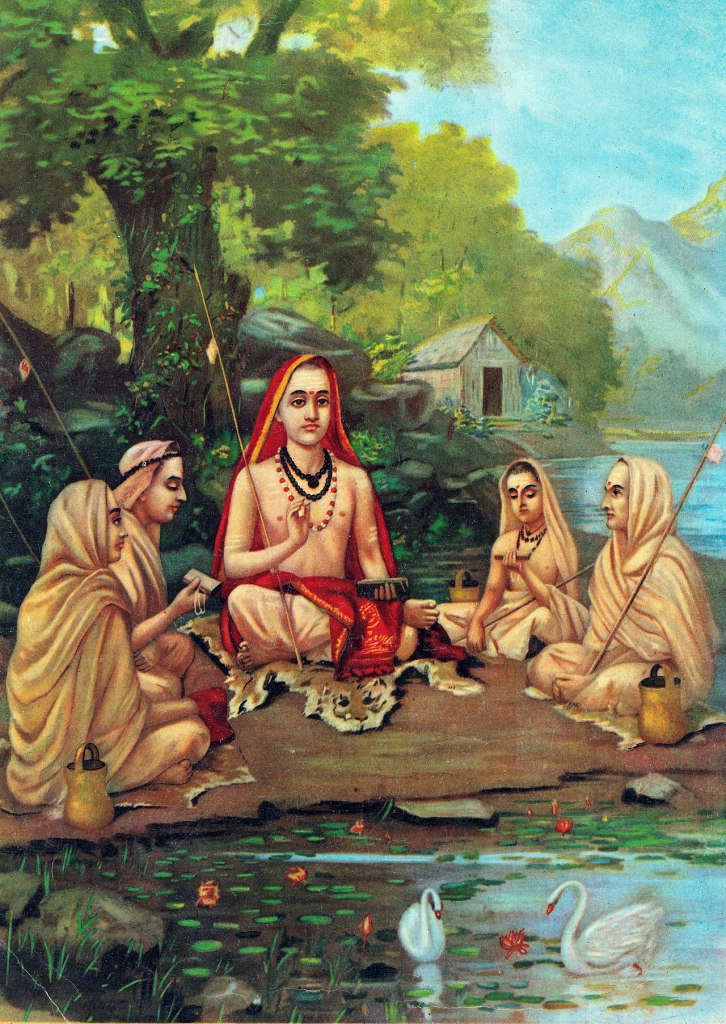
Adi Shankaracharya with Disciples painted by Rajiv Varma 1904Screencap from 2002 Version of this article
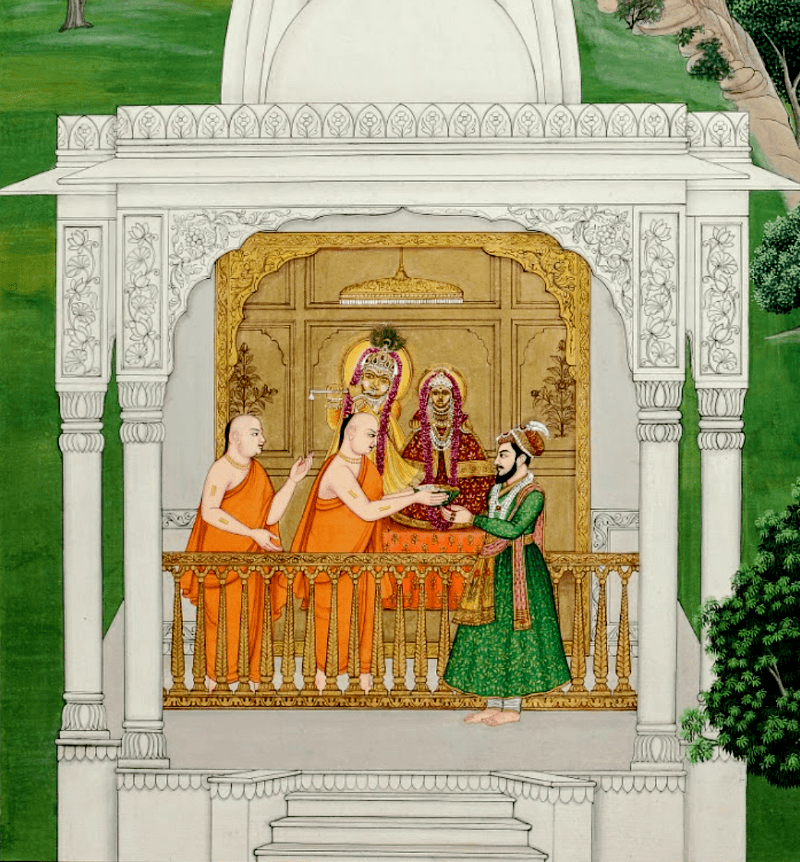
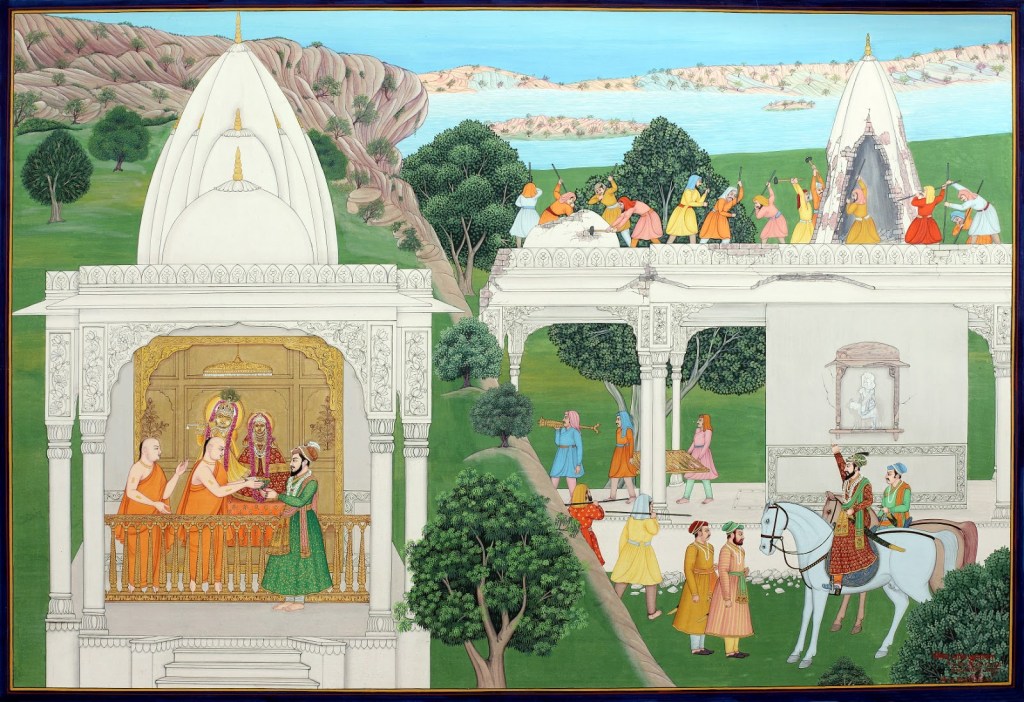
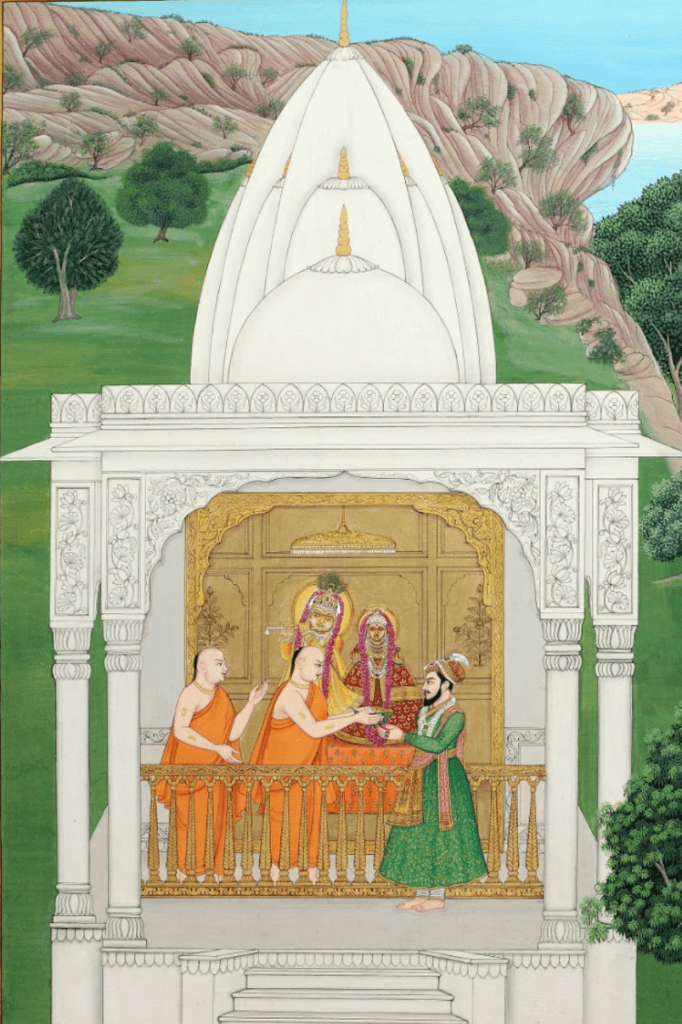
Dara Shikoh Receiving the Prasad of Sri Sri Radha Keshav Rai after presenting a carved railing for the Keshva Rai Temple at Mathura. Later, his younger brother and usuper of the Moghul Throne, Aurangzeb ordered (1666 AD) the demolition of the temple.
Did you know that a Mughal Muslim Prince and Heir-Apparent to the throne of the Mughal Indian Empire completed the translation of 50 Upanishads from its original Sanskrit into Persian? His name was Dara Shikoh and he accomplished all of this before his betrayal and death at the age of 44. His translations are called ‘Sirr-e-Akbar’ or ‘The Greatest Mystery’. This Mughal Prince boldly proclaimed that the work referred to in the Qur’an as the “Kitab al-maknun” or ‘The Hidden Book’, is none other than the ‘Vedic Upanishads’. His most famous work, ‘Majma-ul-Bahrain’ or ‘The Confluence of the Two Seas’ was devoted to the mystical and pluralistic affinities between Islamic and Vedic religions and traditions.
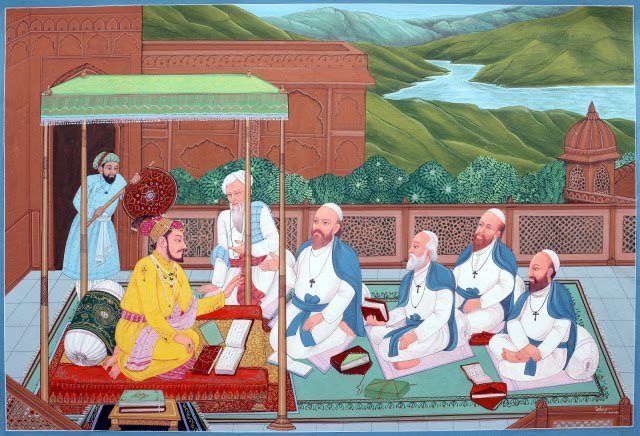
Dara Shikoh translating the Upanishads in the company of Pandits and Sanyasis (1657 AD).
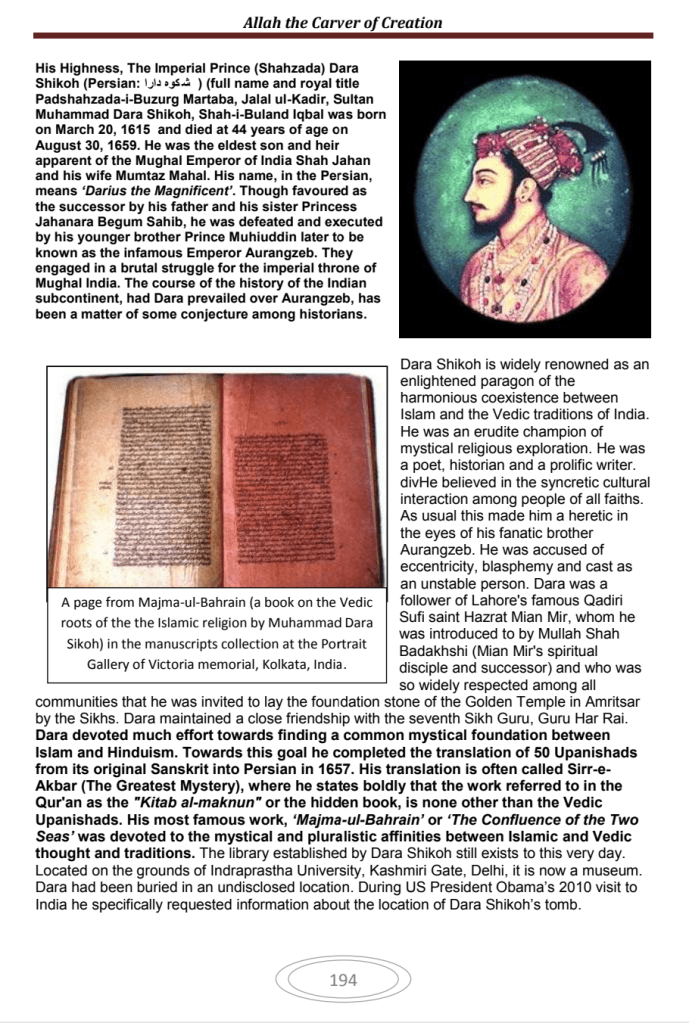
His Highness, The Imperial Prince (Shahzada) Dara Shikoh (Persian: دارا شكوه ) (full name and royal title Padshahzada-i-Buzurg Martaba, Jalal ul-Kadir, Sultan Muhammad Dara Shikoh, Shah-i-Buland Iqbal was born on March 20, 1615 and died at 44 years of age on August 30, 1659.
He was the eldest son and heir apparent of the Mughal Emperor of India Shah Jahan and his wife Mumtaz Mahal. His name, in the Persian, means ‘Darius the Magnificent’.
Though favoured as the successor by his father and his sister Princess Jahanara Begum Sahib, he was defeated and executed by his younger brother Prince Muhiuddin later to be known as the infamous Emperor Aurangzeb, iconoclast and wrathful agent of destruction of countless Hindu temples and pillager of Krishna’s holy city of Vrindavan.
Dara Shikoh interacting with Sufi Saints
The two brothers engaged in a brutal struggle for the imperial throne of the vast Mughal Indian Empire. The course of the history of the Indian subcontinent, had Dara prevailed over Aurangzeb, has been a matter of some conjecture among historians.
Yet clearly, if this noble enlightened prince had become the Emperor of India the world today would see a united India of an enlightened egalitarianism based upon a unified diversity of faiths and religious harmony.
Dara Shikoh meeting with a Group of Christian Fathers to Learn about the Holy Bible & Teachings of Isha – Lord Jesus Christ
Dara Shikoh is widely renowned as an enlightened paragon of the harmonious coexistence between Islam and the Vedic traditions of India. He was an erudite champion of mystical religious exploration. He was a poet, a historian and a prolific writer.He believed in the syncretic cultural interaction among people of all faiths.
If Dara Shikoh had become Emperor, then beautiful Kashmir would today be the epicenter of an effervescent wellspring of learning and culture rather than the potential trigger for nuclear war it is today.
As usual this made him a heretic in the eyes of his fanatic brother Aurangzeb and his Islamist supremacist advisors. He was accused of eccentricity, blasphemy and cast as a mentally unstable person.
Dara Shikoh with Mian Mir and Mullah Shah Badakhshi
Dara was a follower of Lahore’s famous Qadiri Sufi saint Hazrat Mian Mir, whom he was introduced to by Mullah Shah Badakhshi (Mian Mir’s spiritual disciple and successor) and who was so widely respected among all communities that he was invited by the Sikhs to lay the foundation stone of Sikhism’s most holy site, the Golden Temple in Amritsar, Punjab. Dara also maintained a close friendship with the seventh Sikh Guru, Guru Har Rai.
Dara devoted much effort towards finding a common mystical foundation between Islam and Hinduism.
Towards this goal he completed the translation of 50 Upanishads from its original Sanskrit into Persian in 1657. His translations are often called Sirr-e-Akbar (The Greatest Mystery), where he states boldly that the work referred to in the Qur’an as the “Kitab al-maknun” or the hidden book, is none other than the Vedic Upanishads. His most famous work, ‘Majma-ul-Bahrain’ or ‘The Confluence of the Two Seas’ was devoted to the mystical and pluralistic affinities between Islamic and Vedic thought and traditions.
The library established by Dara Shikoh still exists to this very day. Located on the grounds of Indraprastha University, Kashmiri Gate, Delhi, it is now a museum.
During his 2010 Visit to Humayan’s Tomb Obama asked about Dara Shikoh, the eldest son of Shah Jahan who was murdered on brother Aurangzeb’s orders and buried in an unmarked grave on the premises. Dara Shikoh is believed to have had an influence on the 1800s era American Transcendentalists Movement.
Dara had been buried in an undisclosed location. During US President Obama’s 2010 visit to India he specifically requested information about the location of Dara Shikoh’s tomb. I will always be grateful to President Obama for clueing me towards the remarkable legacy of Dara Shikoh the Mughal Prince the rightful Emperor of Mughal India.
As the world is confronted by a cynical atheistic drive towards a Global Religious War, it is the wisdom and legacy of great saints and scholars like Dara Shikoh that provide the solution, resolution and end to all sectarian strife, racial conflict and hatred.
THE DEVELOPMENT OF A UNIFIED DIVERSITY AMONG ALL PEOPLE OF FAITH THROUGHOUT THE WORLD IS THE ONLY GENUINE AND EFFECTIVE PATH TO A GOLDEN AGE OF UNIVERSAL PEACE AND PROSPERITY!
Dara Shikoh’s Investigations of Vedic Literature Reinforced his Islamic Faith. He Recognized his All-Merciful Allah and Islamic Faith as part of the Same Reservoir of God’s Universal Love. Here he and his sons offer Namaz (Prayers) in the Delhi Red Fort Mosque
Humanity is indeed fortunate for the template and blueprint for Religious Harmony bequeathed to us by Dara Shikoh. As soon as we collectively abandon any and all ideas based in racial, cultural, caste, class or religious elitist concepts of superiority, only then can we collectively an easily harness and apply the Dara Shikoh solutions for World Peace. The potential for such a development is thus readily available.
May it Be So and Soon!!! Salaam Alekhum, Shalom, Harih Om Tat Sat!
Unlike Many other Religious Minded Scholars, Dara Shikoh was a Dedicated Husband and Father. Here Dara Shikoh is featured presenting an album of miniature paintings to his wife Nadira Banu.Khalilullah Khan reading a secret letter from Aurangzeb. Betrays Dara Shukoh in the decisive battle of Samugarh (May 1658).
Internal Betrayal by One’s Own People has been the Primary Cause of Foreign Conquest. This Fact is intentionally obscured by modern historians. It is the most potent weapon in the Arsenal of the Adversary (Kali Yuga Personified/Satan/Shaitan). Thus today it is being used as a weapon against innocent majority populations of the world; be it the ‘White Guilt’, ‘Hindu Bigot’ or the ‘Islam is Terrorism’ Narratives. Poisoning the Heart & Soul of Humanity.
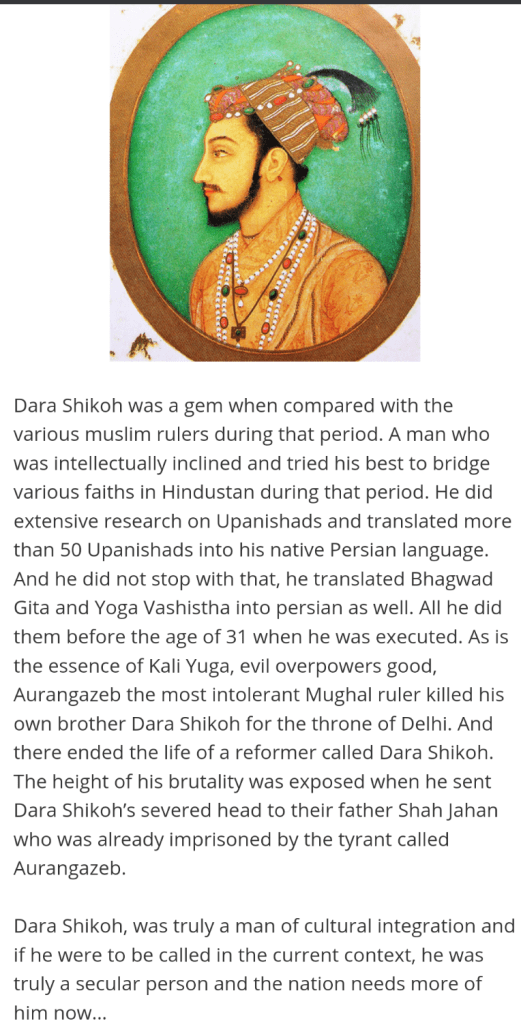
From: DARA SHIKOH, A MUGHAL WHO WAS TRULY “SECULAR” by GopalaKrishnan V, Founder CEO of Money Avenues(Note: Dara died at 44 not 31)Source: The Serpent the Eagle the Lion & the Disk
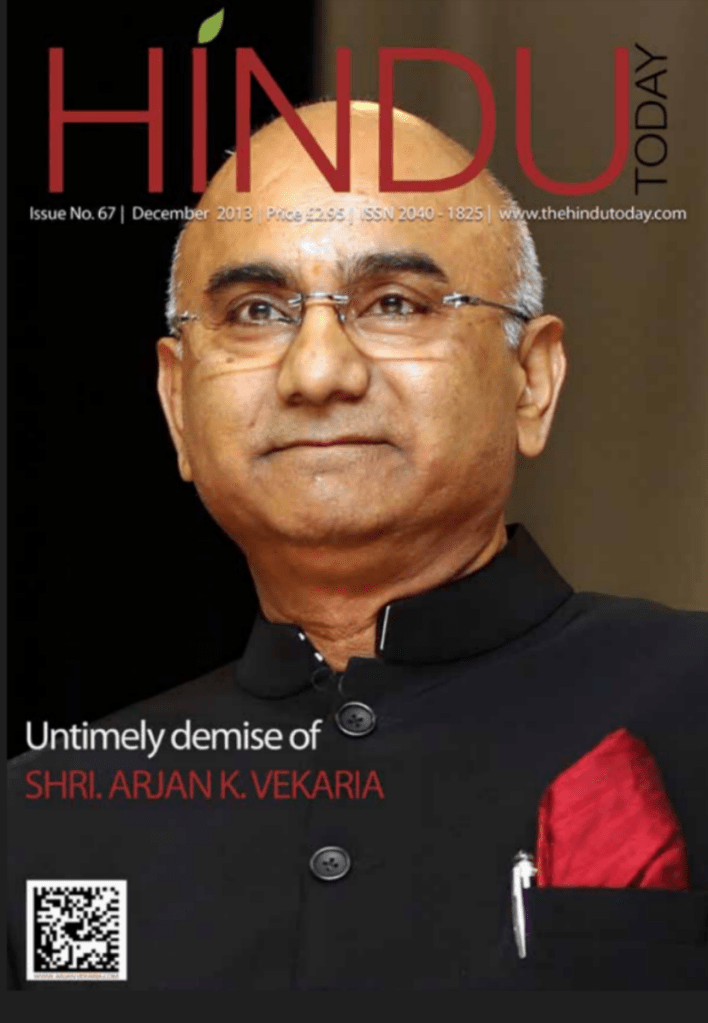
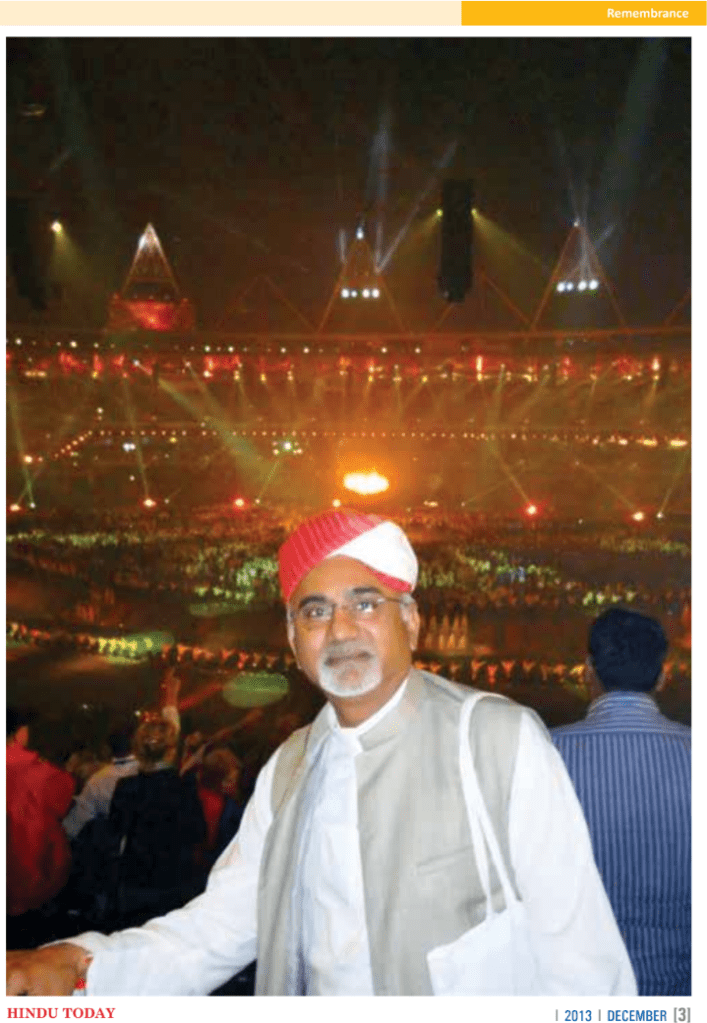
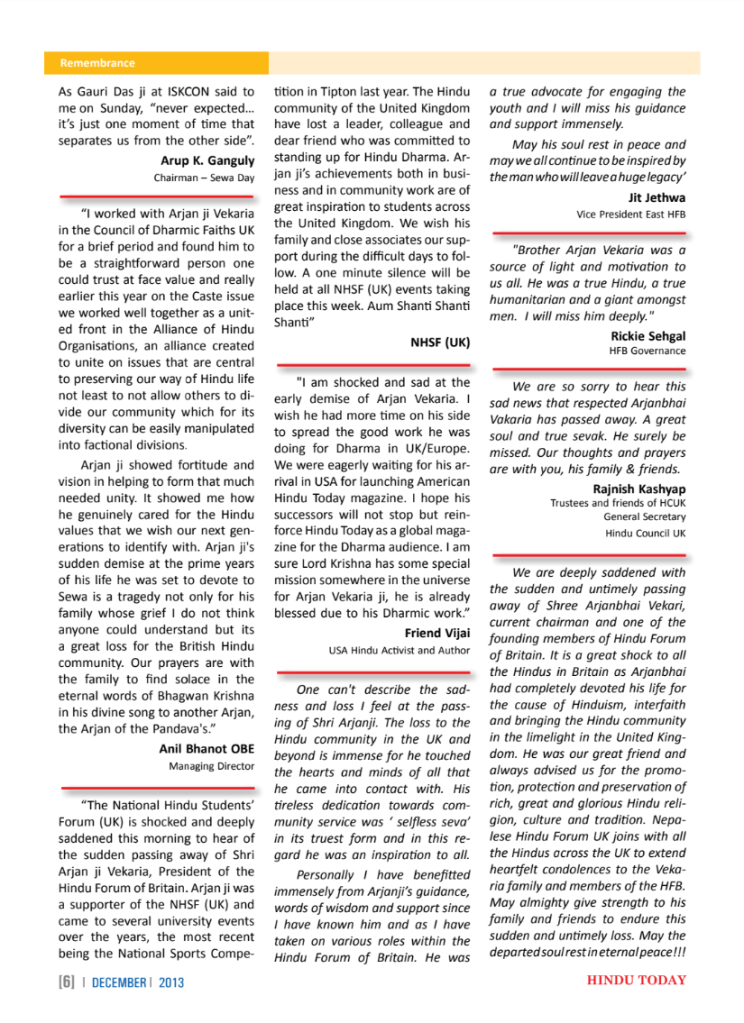
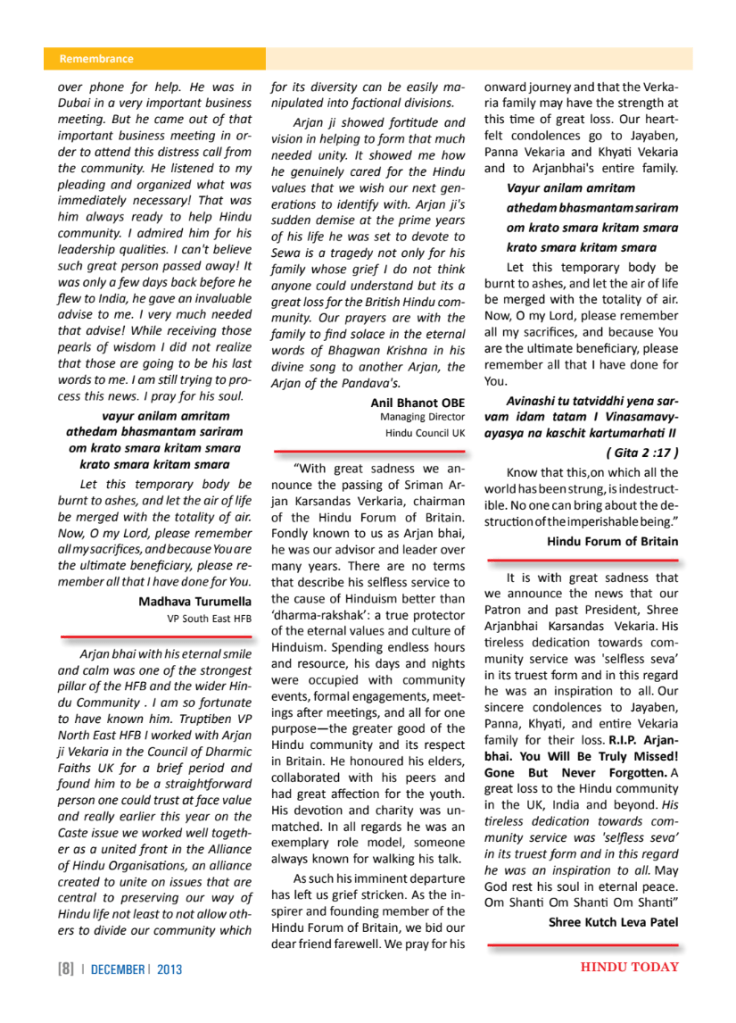
Even before his success in business, Arjan Vekaria had been a dedicated humanitarian. During his childhood in Africa, he was involved in several charitable campaigns. In his early days in the UK he would go door to door collecting funds for Indian orphanages.
His charitable activities extended beyond the ethnic barrier as well and thus from 1985- 87 he spearheaded the SKLPC (UK) Ethiopian Famine Relief Fund Drive. Then in 1987/88 he coordinated the Gujarat Drought Relief Fund and after the massive earthquake of 2001 he was the Chief Coordinator for the Relief and Reconstruction for Gujarat Earthquake from 2001 until 2004.
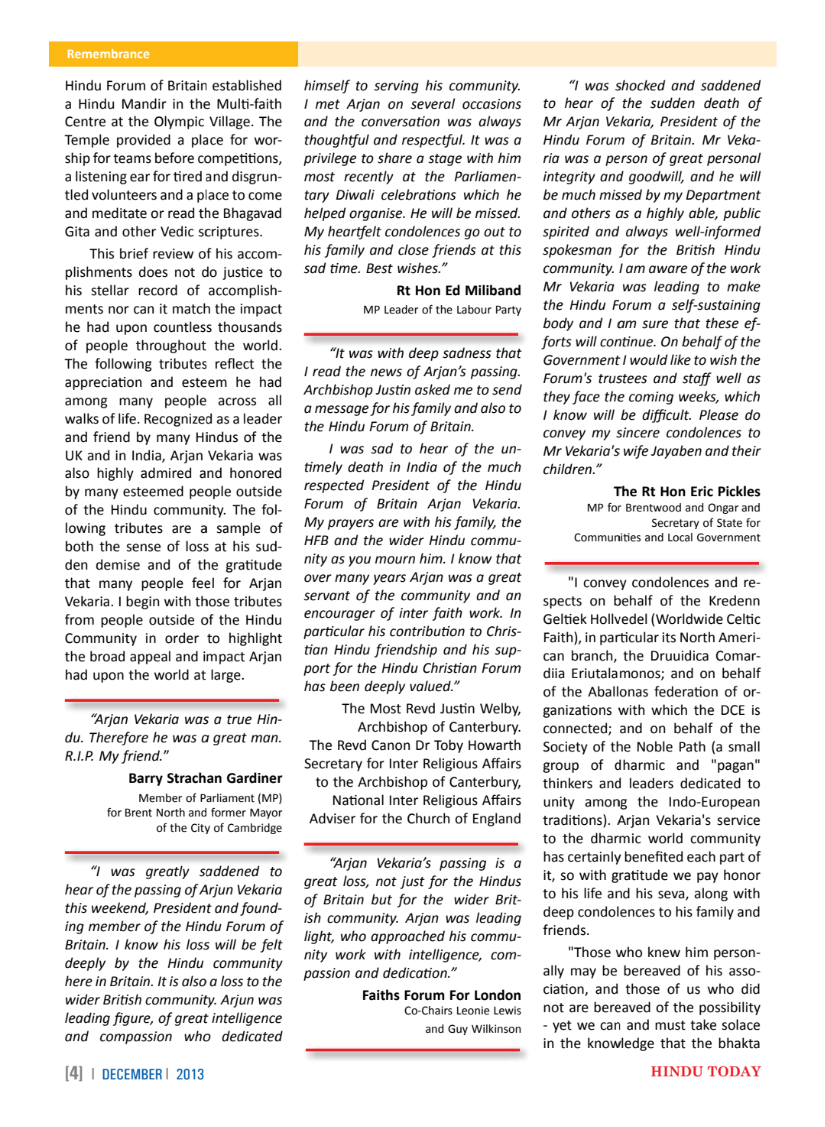
Arjan’s obvious dedication to selfless service was recognized far and wide throughout British society. He was thus appointed to many prestigious positions such as Governor of Copland Community School in 2007, Trustee of the Asian Foundation for Help (UK); Elected President of Hindu Forum of Britain in 2009 the largest umbrella body for British Hindus, Trustee and Vice President of Shree Navchetan Andhjan Man dal Kutch India, honored with the Community Personality of the Year Award by the UK Home Secretary and Minister of Justice.
In 2010 Arjan was appointed as one of 13 faith advisers by the UK Government’s Communities Secretary John Denham. Arjanji also had the distinction of being a Justice of the Peace (Magistrate) appointed by the Lord Chancellor on behalf of HM The Queen. Despite representing the world’s third largest religion with a massive and economically vibrant middle class population, Hindus have a miniscule media presence. In an effort to fill this gap, Arjan Vekaria and his brother Shashi founded Hindu Today Magazine in 2007.
Thus the world’s only Pan-Hindu monthly magazine was born. Yet, within a month of the demise of Arjan Vekaria, Hindu Today Magazine was no more; but not before making a significant impact on the history of the world. As a direct result of the publication of our Hindu Yezidi Cultural similarities, two of the world’s most ancient Civilizations were once again reunited.
EDITORIAL, Aug 8 (VNN) — Los Angeles, CA – April 10, 2000
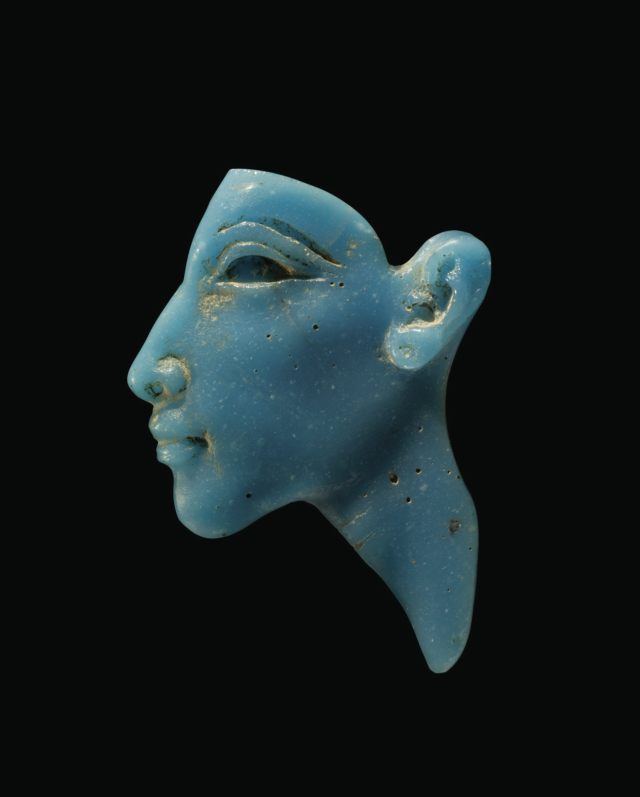
Recently, the Los Angeles County Museum of Art held an exhibit called “Pharaohs of the Sun“. It turned out to be the most popular exhibit ever. The exhibit featured artifacts from the reigns of Akhenaten, Nefertiti, and the famous King Tut.
Modern scholars claim that Akhenaton was the worlds first known monotheist. However, the fact is, he was actually reviving an ancient monotheistic religious tradition. Unknown to most is the true nature of this religion. This religion was not only Vedic, but was actually an Indigenous Egyptian form of Vaisnavism.
Research has proven Akhenaton’s Vedic roots through his familial connections to the Hurrian/Mitanni peoples. Everyone agrees that the Mitanni were a Sanskrit speaking and writing people and they worshipped the Vedic gods. What is forgotten is the fact that Akhenaton’s father, his mother, and wife were all related to the Vedic Mitanni. Thus, it is no surprise that Akhenaton’s religion and Vedic religion share so many vedic similarities. The research of BhaktiAnanda Goswami has proven the Vaishnava nature of his religion.
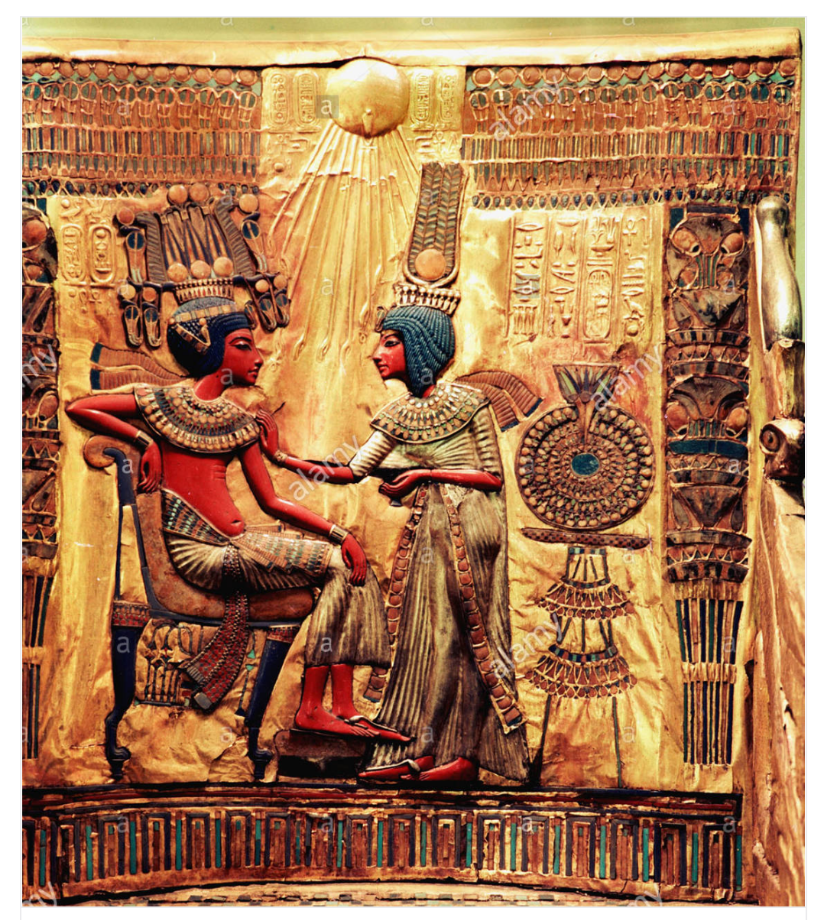
Detail of the throne of Tutankhamun. Queen Ankhesenamun holds a salve-cup and spreads perfumed oil on her husband’s collar in a typical Amarna style scene. The sun-disc Aten shines above the royal couple. Country of Origin: Egypt. Culture: Ancient Egyptian. Date/Period: 18th dynasty 1327 BC. Material Size: Wood, gold, silver & precious stones.
On April 10, 2000, BhaktiAnanda Goswami of E.O.H.N. (Ecumenical Order of the Holy Name), and Vedic Empire Productions put together a tour and presentation on Akhenaten’s Vedic/Vaishnava past. During the two hours of the tour BhaktiAnanda Goswami enthusiastically pointed out the various vaishnava connections. Again and again he amazed and enlightened the tour participants. It is truly amazing how many ancient artifacts are related to the worship of Hari. Using the torchlight of knowledge, BhaktiAnanda Goswami clearly revealed the Vaishnava nature of Akhenaton’s religion. During the tour, many people unconnected to our group were intrigued and asked intelligent and sincere questions which BhaktiAnanda Goswami answered.
The program continued that evening at the Los Angeles Hare Krishna Temple where BhaktiAnanda gave a detailed talk on various examples of the ancient world’s global Vaishnava traditions. Using a scientific approach called linguistic archaeology, some of the key points he presented are as follows: 1) The original forms of the Supreme Personality of Godhead worshipped in the Mediterranean region were Radha-Krishna and Balarama. The center of this ancient Vaishnava culture was the Greek Isle of Rhodes.
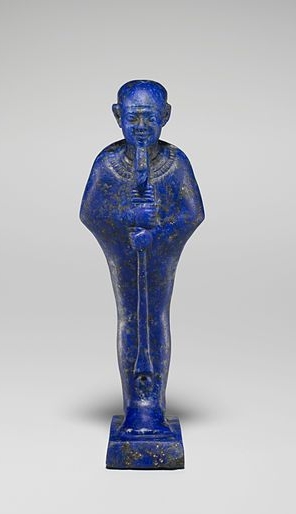
950 BC Creator Ptah Divine Father Pita Lapis Lazuli
2) Jews, Egyptians, and Europeans all worshipped Lord Krishna in many forms all familiar to the modern day Vaishnava. Forms such as Matsya, Kurma, Narasimha, and Kalki. This tradition was called Heliopolitan because they worshipped Helios (Greek for Hari).
3) Hundreds of Jewish, Egyptian, and Greco Roman deity names (theophoric names) can be clearly identified as names of Krishna or Vishnu.
4) Official religious emblems, including the state seals of the Jewish kingdoms of Israel and Judah, were indisputably Vaishnava symbols, and directly connected to Akhenaton’s religion and the eternal Vaishnava traditions of India.
5) In ancient Egyptian religion, creation began from the form of NHRYN (Narayan) lying on the primordial waters. A lotus grows from His navel, and on this lotus appears the four armed and four headed Heliosphanes (Brahma) who speaks creation.
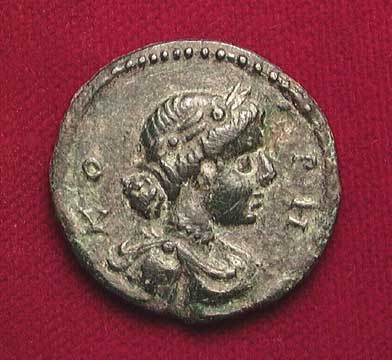
The Chios KoreAncient Cretan Korous 600 BC
6) Ancient Mediterranean Vaishnavism can be properly understood when we compare it to the authentic Vaishnava scriptural sources especially Bhagavad-Gita, and Srimad Bhagavatam, where the viratarupa (Universal Form) conception of the Supreme Lord is revealed. For example, Krishna’s self revelation in the “I Am” verses of the Bhagavad-Gita directly parallels the great hymns of HR-Heri of ancient Egypt. Therefore, ancient Egyptian religion considered HR-Heri the origin of all gods and deities. That is why they used the name HR-Heri or Asu (Vasu) along with deities considered to be aspects of Heri. Thus, the god of wealth was called KPHR/Kepe-Heri because in the Gita Krishna says “·I am Kubera”.
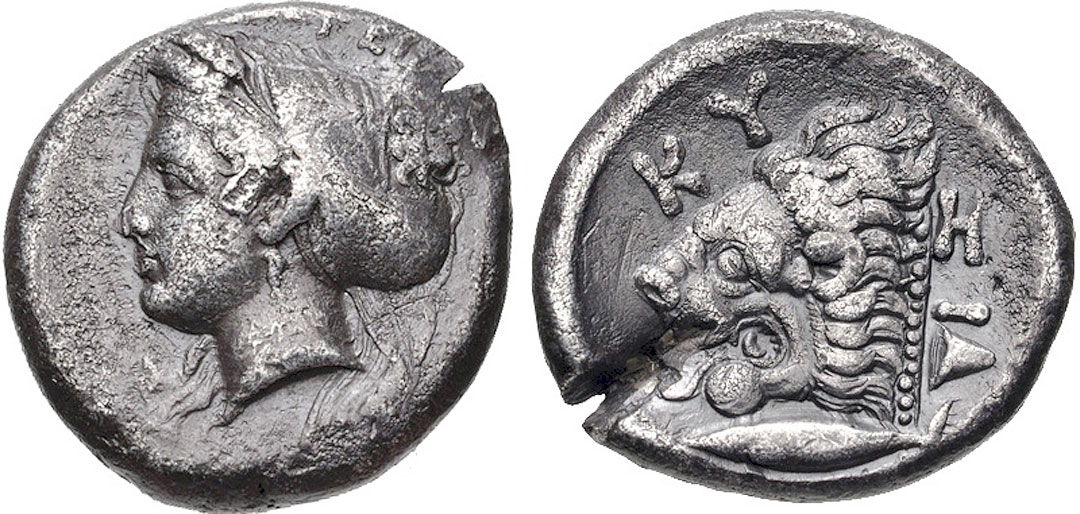
7) Being authentic followers of Vaishnavism, ancient Heliopolitan cities always had a presiding deity of Helios (Hari). He was always worshipped with His Fortuna (Goddess of Fortune or Shakti). Evidence shows that the original form of Helios (Hari) was worshipped on the Greek Isle of Rhodes as Kouros. The original form of Fortuna was named Rhoda.
8) Even modern scholars accept that Kouros was considered the origin of all the Greek gods. He is described as a beautiful youth tending His sacred white cows with His elder brother and friends. He plays a flute and leads the boys in dance as they clash their cymbals. He dances with Rhoda and Her expansions in a circle dance named after Him called the Chorus Dance. As the Lord of the Dance He is called Choreagos from which is derived the modern word ‘choreographer‘. The peacock feather was the pre-eminent symbol of both Helios and Kouros. Throughout the region Helios (Hari) was worshipped as the Lord of the Heart and the Supreme Personality of Love. That is why He is the Lord of all living entities, cultures, and traditions.
All of this evidence highlights the fact that we are all rooted in the tradition of pure devotional service to Sri Sri Radha Krishna and Balarama. BhaktiAnanda Goswami hopes that his research can be instrumental in reuniting all of God’s children and awaken the world to its common heritage as the people of Hari.
Peplos Kore, cast and reconstruction, Cambridge Museum of Classical Archaeology
Pendant with Painting of Rani of Jhansi, Lakshmi Bai
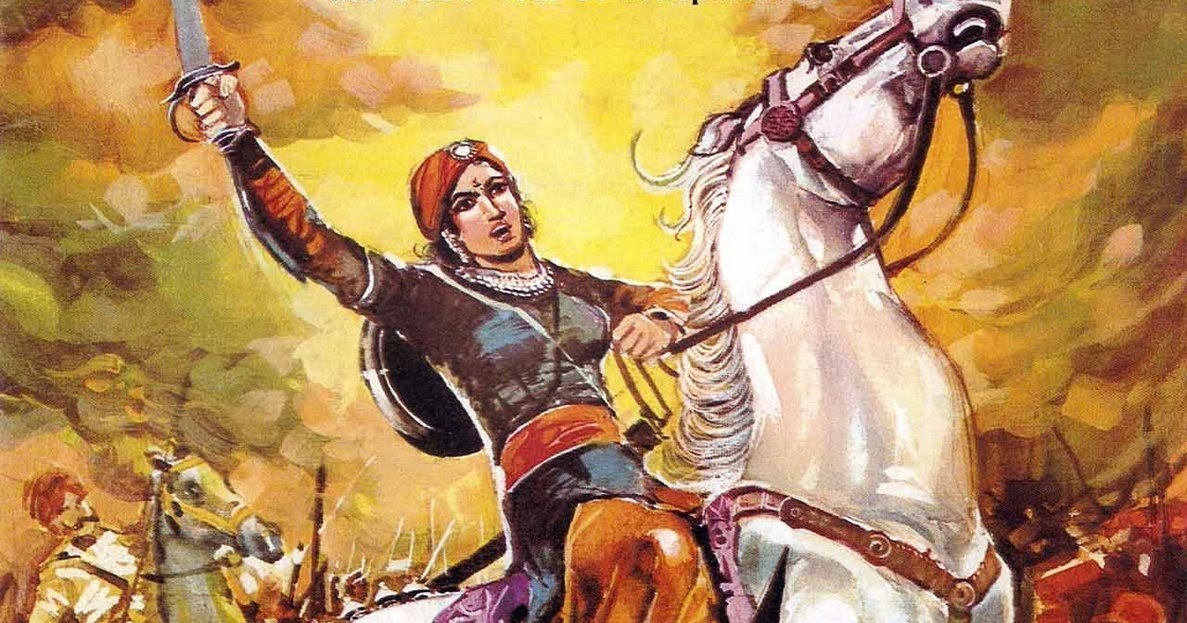
Many have spoken of Ram-Rajya or the ideal Vedic Kingdom. Most believe it to be a mythological ideal that may or may not have existed thousands of years ago. Yet history reveals that a such an ideal functioning Vedic administration existed as recently as 1858 AD. This was a functioning Vedic government led by an ideal Vedic Ruler. She was Queen Lakshmi Bai, the famous Rani of Jhansi. Noted as a brave warrior and military leader, she died at 29, battling the British. She was a living legend even during her short reign and lifetime. Long a source of inspiration, Lakshmi Bai remains as an icon of Independence and the Heroic Spirit.
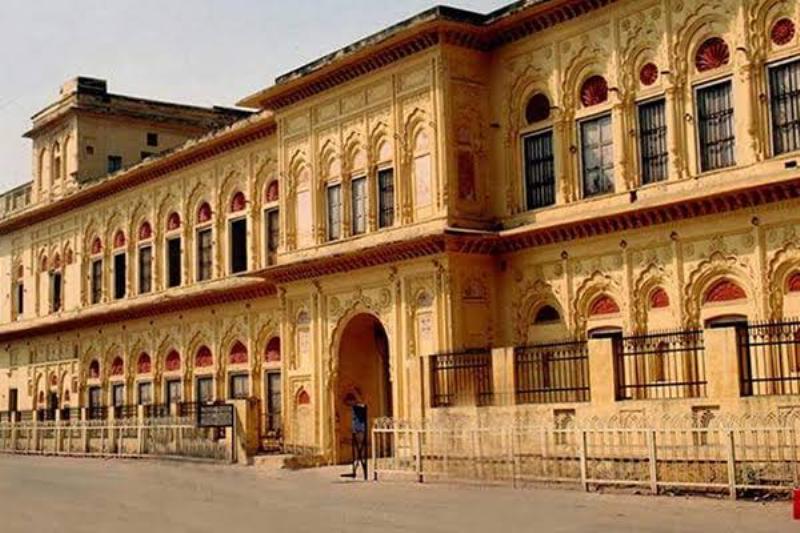
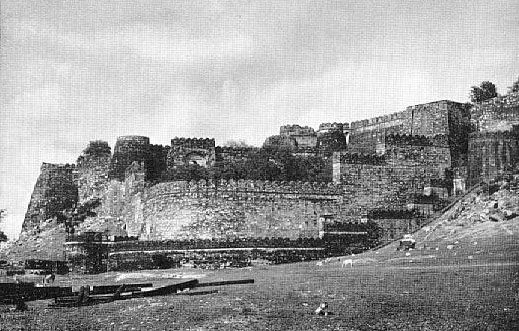
Royal Palace of Jhansi
Below is a very brief account from the book `Rani of Jhansi -Lakshmi Bai’ by E. Jaiwant Paul. It highlights a rare glimpse into the actual functioning of a Vedic based administration and governing system.
“The Rani’s daily routine at this time was to get up at 5 am. The first thing she did was to exercise in the gymnasium. She spent an hour or two every day practising with Indian clubs and honing her skills with the sword, wrestling and horse riding. She would then take a bath with fragrant attar (of roses) and wear a Chanderi sari of faultless white. She would next sit down for her daily prayers and worship with the court musicians providing the music for the puja.
Later in the morning the sardars and other state officials came to pay their respects. There were one hundred and fifty of them and even if any one of them failed to turn up, her keen eye would notice the absence and the next time they came, she would ask the reason for it. After lunch she would take an hours rest, unless there was some urgent work. At 3 pm she held the durbar (audience).
For this function she usually wore male attire, which consisted of Jodhpur breeches, a blue silk jacket and a turban. A sash went around her waist in which she carried a sword, the hilt and scabbard of which were embellished with rubies.
She was tall and beautiful and her attire added to her already impressive presence.
Occasionally for the durbar, she opted for conventional garments and wore a white sari with several strings of pearls around her neck and diamond studded bangles and rings. She sat on a gaddi or throne, flanked by two attendants bearing maces (clubs) damascended with silver and gold.
Jhansi Ganesh Mandir
At the durbar Diwan Lakshman Rao, the Chief Minister, presented the relevant documents to her which she quickly scanned and issued clear and precise orders. She would sometimes write her orders in her own hand but usually she issued them orally to be taken down by clerks. Hers was an open court and anyone who had a grievance could walk in and present their case. She decided civil and criminal cases on the spot.
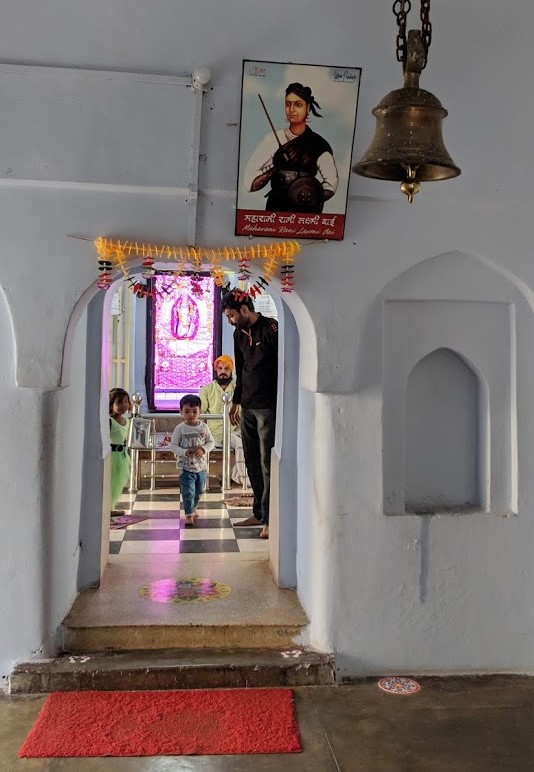
The Maha Lakshmi Murti at the Mahalakshmi Temple of Jhansi worshipped by Queen Lakshmi Bai. Maha Lakshmi was also her ‘clan’ Kuldevi, Family-Goddess. Jhansi’s Maha Lakshmi Temple and Lake today
Twice a week the Rani and her son went in procession to the Maha Lakshmi Temple with its lake filled with lotus flowers. The procession was an impressive one and wound through the main streets of the city. Sometimes she went on horseback and at other times by palanquin decorated with curtains and gold brocade.
The Interior of the Mahalakshmi Temple features a Portrait of Queen Lakshmi Bai
Her ministers, feudatories and other officials mounted on horses accompanied her. At the head of the procession was a drummer and a flag-bearer while the rear was taken up by a mounted escort of soldiers in Maratha uniforms. A further touch of glamour was added by her beautifully attired handmaidens who walked alongside her palanquin. If it became dark, men bearing flaming torches lit the way. At the palace gates, the melodious notes of the shenai greeted her return.
One cold wintry evening, while returning from the temple she saw the poor of the town in course cotton garments huddling around a hastily built fire in the by-laws of the city. She got down from the palanquin and asked them all to come to her palace in four days time. All the tailors of the town were kept very busy for those four days. When the poor in their hundreds gathered in front of the palaces, every one of them was handed over a woollen jacket, cap and a blanket.”
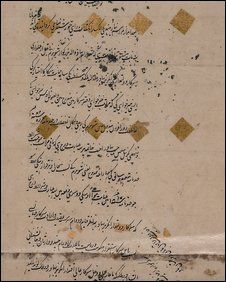
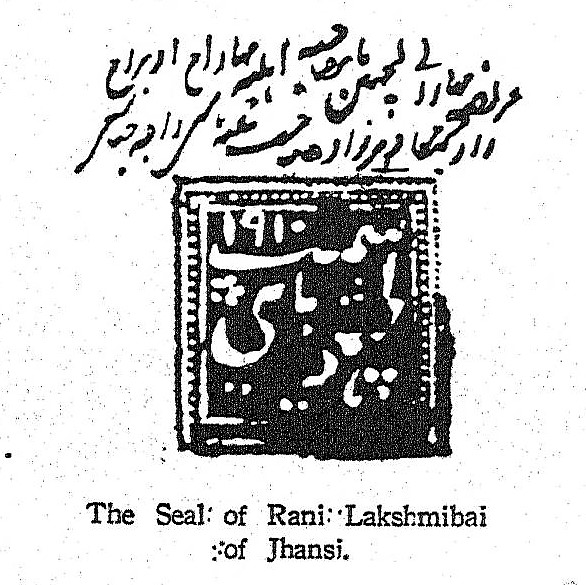
A letter written by Rani Lakshmibai in the Persian Language; citing the hypocritical tricks of Lord Dalhousie for annexing the kingdom of Jhansi, found 2009 in the British Library, UK.Royal Seal of Rani Lakshmi Bai Fortress of Jhansi 1880sSamadhi Stahl Tomb of Queen Lakshmi BaiJhansi ki Rani 1953 India’s First Technicolor film was on the life of Queen Lakshmi Bai‘The Tiger and the Flame’ 1956 Promotional Poster/Serbian
Watch ‘The Tiger and the Flame‘ (JHANSI KI RANI, 1953) is quite an unusual film, a big-budget Indian historical epic filmed in English, billed in the credits as “India’s First Picture in Color by Technicolor.”
Source: Rani of Jhansi – Lakshmi Bai – A Tribute to Lakshmi Bai, the Rani of Jhansi, the Legendary and Valiant 19th-century Queen, who lives more in ballads, folk tales and stories of Bundelkhand, Central India, than in written accounts. Available Here
































 History & Culture